E-paper dashboard
A battery-powered Home Assistant display that sleeps most of the time.
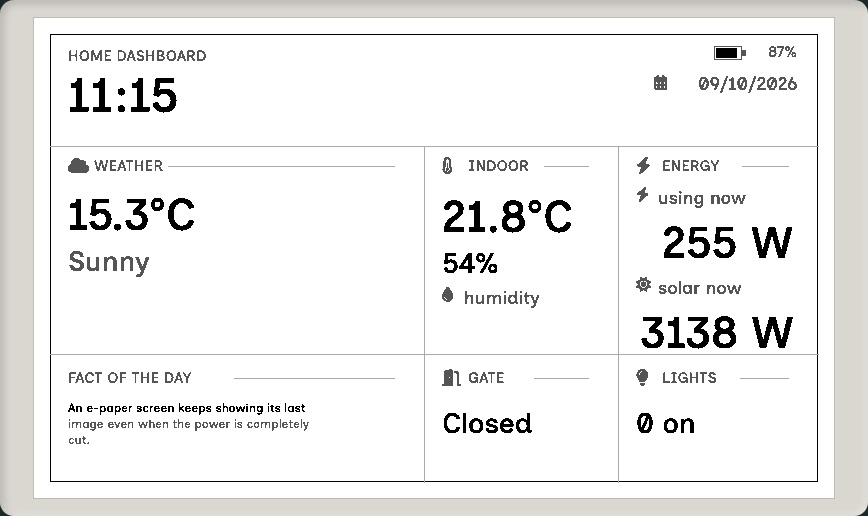 Live demoTry the simulatorThe real screen layout from the firmware, redrawn in your browser with made-up data. Wake it up, watch the e-ink refresh, break the wifi, and see what deep sleep does for the battery.
What it is
A dashboard for my dad's Home Assistant setup. It shows the time, weather, indoor temperature and humidity, power use, solar production, whether the gate is closed, how many lights are on and a fact of the day.
It hangs on the wall without a cable, so it has to run on one battery for as long as possible.
How it works
The ESP32 only stays awake until it has wifi, the data, the time and a battery reading. Then it works out how many seconds are left until the next quarter hour and goes into deep sleep for exactly that long. An e-paper screen keeps its image without power, so the display never goes blank.
All Home Assistant data comes in through one template sensor in a single REST call. Changing which lights or sensors are shown happens in Home Assistant, without flashing the device again.
The firmware is ESPHome with display code in C++. Everything sits on a carrier PCB I designed myself.
Highlights
- Hardware: ESP32, a Waveshare 7.5 inch 800 by 480 e-paper panel, a 3000 mAh LiPo, TP4056 charger, MT3608 boost converter and a MAX17043 battery gauge on I2C.
- The panel runs in four shades of gray through a custom driver that packs two bits per pixel into two bit planes.
- If wifi fails, it starts its own hotspot after 15 seconds, and after a minute the screen shows a setup page with QR codes instead of staying blank.
- The fact of the day is fetched at most once a day and stored in flash, so deep sleep does not wipe it.
- The battery gauge is put to sleep too before the ESP32 sleeps, and the power switch sits before the gauge so "off" really is off.
What was hard
Every second awake costs battery. Connecting to wifi, fetching data and reading the gauge had to be as short as possible, and the gray-scale refresh itself takes several seconds. It took so long that the watchdog timeout had to go up to 12 seconds.
The development board keeps drawing power in deep sleep through its power LED, USB chip and regulator. The next version of the PCB uses a bare ESP32 module with a better 3.3 V regulator, which the simulator shows as "Next PCB".